
Ask ten New York designers where they trained and you will hear the same few names. That is not an accident. The city’s fashion schools grew up alongside its garment industry, and each one reflects a different answer to the question of what a fashion education is for: craft, art, business or all three. Here is a short, sourced guide to the four you will hear about most.
FIT: the industry’s own college
The Fashion Institute of Technology was created by the trade itself. According to FIT, in the 1940s apparel manufacturers worried that their children “wanted to be doctors and lawyers—not tailors,” so a group led by educator Mortimer C. Ritter and retired menswear manufacturer Max Meyer set up a foundation and obtained a state charter. The institute opened in 1944 with 100 students on the top two floors of the High School of Needle Trades.
In 1951 FIT became the second community college in the State University of New York system empowered to grant the Associate in Applied Science degree. It moved into its own building on Seventh Avenue in 1959, and a 1975 change to state education law allowed it to offer bachelor’s degrees. That public status still shapes its price. FIT’s catalog lists 2026-27 full-time tuition for New York City and State residents at $2,895 per semester at the associate level and $3,585 per semester at the bachelor’s level, against $8,685 and $10,846 for out-of-state students.
The campus also houses the Museum at FIT, one of the few specialized fashion museums in the world. (See our guide to the museum.)
Parsons: an art school that invented design programs
Parsons began in 1896, when the painter William Merritt Chase founded the Chase School in New York, according to The New School. Frank Alvah Parsons joined in 1904 and became director in 1911. He launched pioneering programs in fashion, interior and graphic design at a time when most art schools did not treat them as serious subjects. The school took his name in 1941, and in 1970 it joined The New School.
Its archives also hold part of New York’s design history. Willi Smith, for example, enrolled in its fashion program in 1965 on two scholarships, according to Cooper Hewitt.
Pratt: Brooklyn’s practical idealists
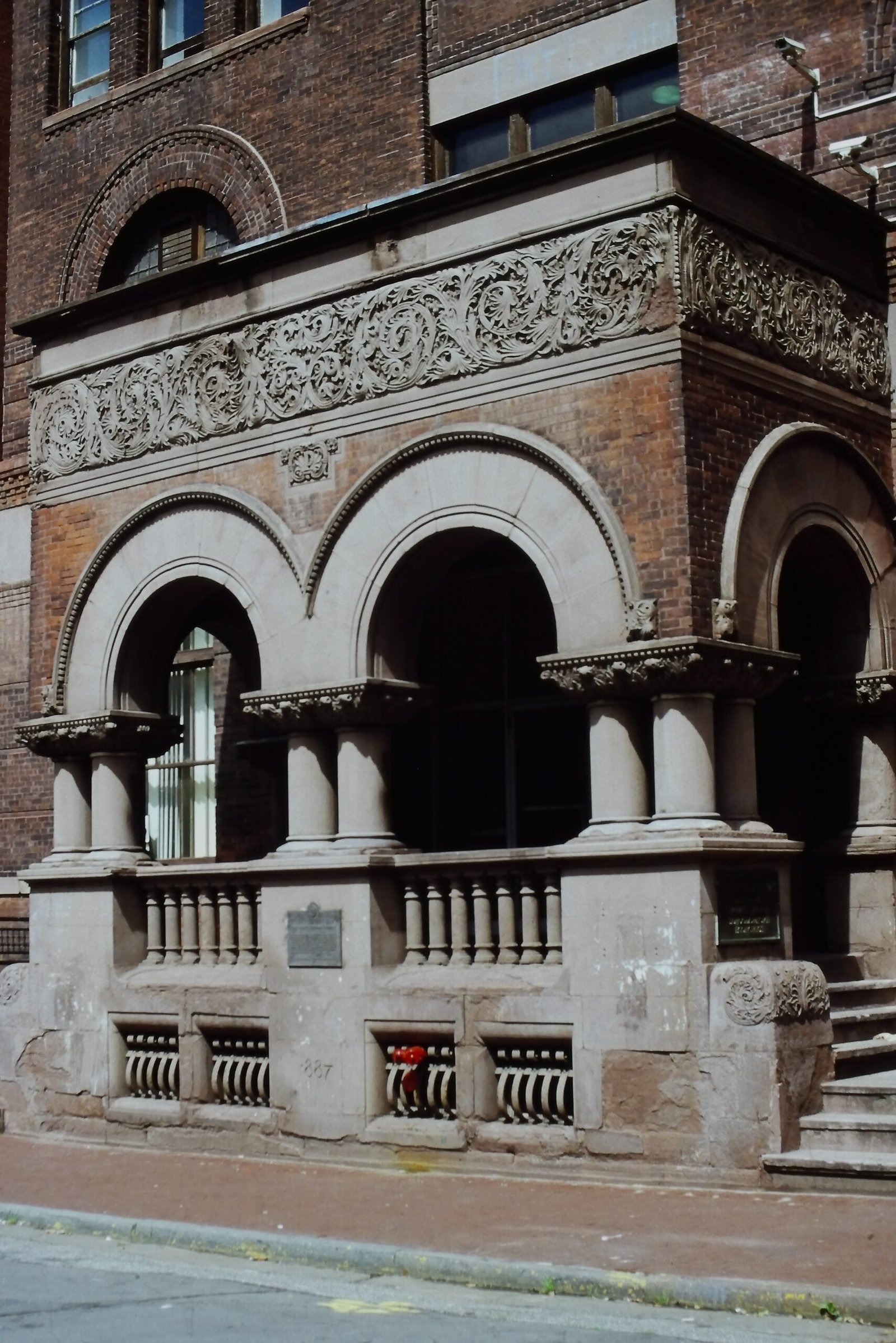
Pratt Institute was founded in Brooklyn in 1887 by Charles Pratt. The institute says his mission was “to provide an affordable college education to all students regardless of class, color, or gender” at a time when the city’s economy was rapidly industrializing. Today its Fashion BFA, a 126-credit degree in the School of Design, is described by Pratt as “deeply hands-on, grounded in material exploration,” with a focus on sustainable design, a Textile Dye Garden on campus and internships in New York’s fashion industry.
For students who want a campus outside Manhattan with a strong fine-arts culture, Pratt is often the reason to look across the river.
LIM College: the business of fashion
Not everyone in fashion designs. LIM College was founded in 1939 by Maxwell F. Marcuse, who, according to the college, was asked by leading retailers to create a school for “the business of fashion and merchandising.” It was originally called the Laboratory Institute of Merchandising and became LIM College in 2009. In December 2025, the college says, it was acquired by Japan Educational Foundation and became part of that group’s international portfolio of schools.
LIM is a reminder that the industry’s largest workforce is in buying, merchandising, marketing, logistics and retail management, not on the runway. (Our guide to fashion careers maps those jobs.)
How to choose
The U.S. Bureau of Labor Statistics notes that more than 360 postsecondary institutions are accredited with programs in art and design, and that employers rely heavily on portfolios when hiring designers. A school’s name matters less than what you leave with. Before you apply, ask:
- What will I make? Ask to see recent student portfolios and graduating collections, not just alumni lists.
- Who teaches the technical classes? Pattern-making, draping and sewing are learned from practitioners. Find out how many faculty work in the industry now.
- How do internships work? Ask how many students place in internships each year and where.
- What does it really cost? Compare tuition, studio fees, materials and housing. The difference between a public and private school in New York can be very large.
- Can I study part time? Several schools offer evening, non-degree or continuing-education courses. These can be a smart way to test your interest before committing.
Beyond the big four
New York’s fashion education does not end at a campus gate. Museum programs, symposia and free lectures, such as those at the Museum at FIT, are open to everyone, and the Garment District’s own business programs offer free technical consultations to new brands. (See how the Garment District works for new labels.) The best-trained designers in this city tend to use all of it.
Find talent in the MOAM directory · Subscribe to The MOAM List · Follow MOAM on Instagram @moam_co and Facebook makingofamogul · Tips and corrections: hello@makingofamogul.com
Sources
- FIT, Our History
- FIT Catalog, Tuition and Fees 2026-27
- The New School, Parsons History
- Cooper Hewitt, Willi Smith Street Couture: Beginnings and Career
- Pratt Institute, History
- Pratt Institute, Fashion BFA
- LIM College, Our History
- U.S. Bureau of Labor Statistics, Occupational Outlook Handbook: Fashion Designers
Photo credits: “Richardsonian Romanesque – Brooklyn, NY – Pratt Institute (Main Building) (5)” by Bmzuckerman, via Wikimedia Commons, CC BY 4.0 (https://creativecommons.org/licenses/by/4.0)
Editor’s note: facts in this article were checked against the linked sources in October 2026. Tuition figures are FIT’s published 2026-27 rates and change annually; LIM College’s ownership change is as reported on its own site.
Leave a Reply