
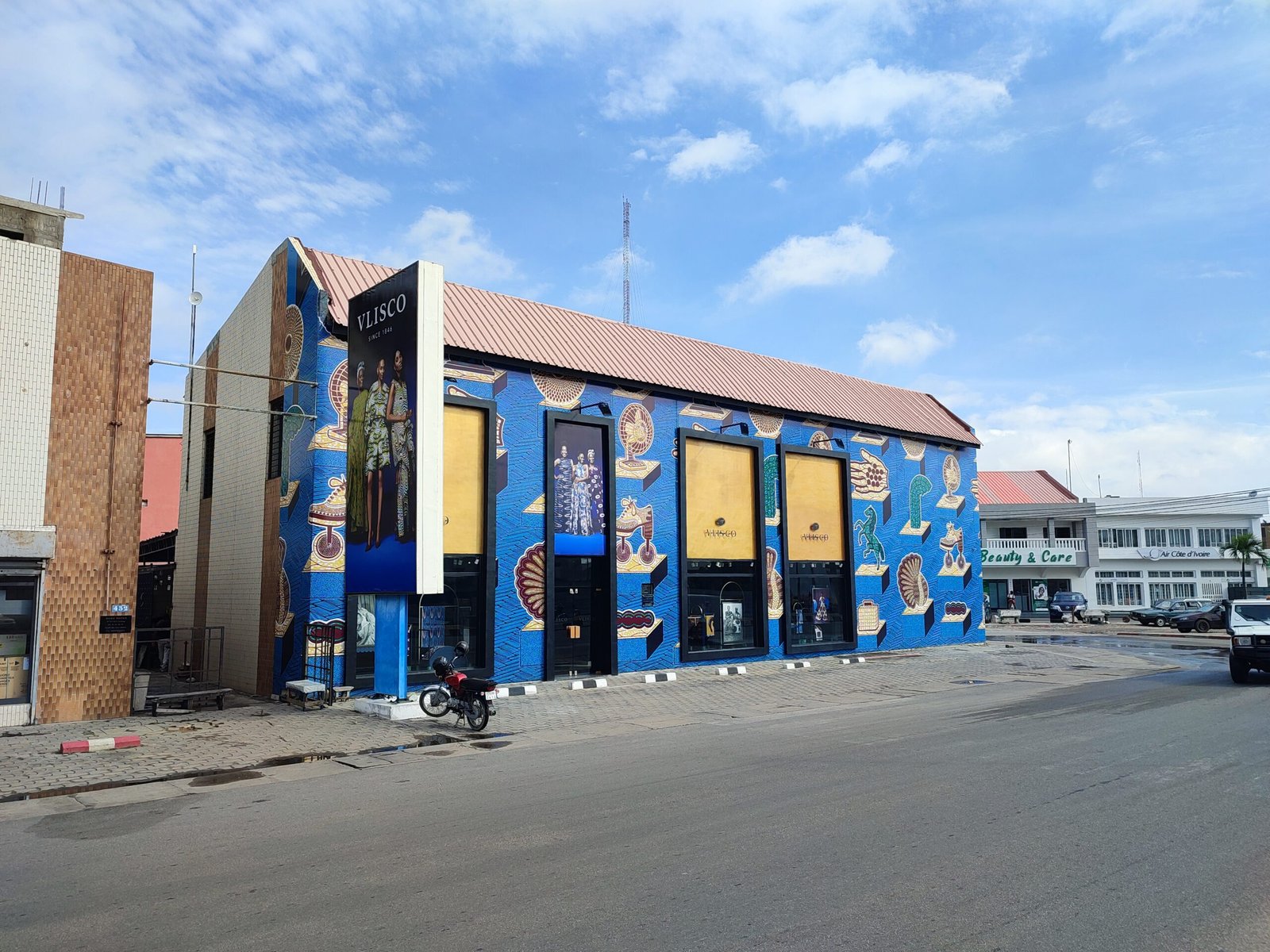
Walk through a market in Accra, Lagos, Lomé or Cotonou and you will see it everywhere: cotton printed in saturated colors, with a soft, slightly crackled outline and patterns that range from abstract circles to handbags, birds and alphabets. Worn by millions and embraced across the diaspora as African, wax print has one of the most tangled histories in fashion.
An imitation of Javanese batik
Wax print began as an industrial copy. The Wereldmuseum in Amsterdam explains that 19th-century Dutch textile makers produced wax prints for the Dutch East Indies, where imitation batiks were popular. Wax print is an industrial version of batik: a roller-printing machine coats bleached cotton on both sides with a resist made of wax and resin, and wherever the resist sits, the cloth stays undyed during the next printing pass.
The best-known maker is Vlisco, in Helmond in the southern Netherlands. According to the Philadelphia Museum of Art, the company was founded in 1846 and soon began exporting imitation batiks to the Dutch East Indies, today’s Indonesia. About three decades later it found a new market in West Africa. The Wereldmuseum says the shift came when authorities in Batavia closed their borders to European textiles at the end of the 19th century and trade moved to West Africa, where designs and colors were increasingly adapted to African taste.
Vlisco was not alone. The research site Asian Textile Studies records Swiss printers producing imitation batiks from 1841, and the English firm ABC Wax making wax prints in Hyde, near Manchester, from 1908, before moving production to a factory in Ghana in 2005. Today, the Philadelphia Museum of Art notes, wax prints are also made in China and India.
The signature look
Asian Textile Studies describes the qualities buyers look for in “Real Dutch Wax”: cotton printed in bold, vivid colors, with a soft appearance and blurred edges that include a crackle effect imitating hand-made batik. That crackle, where dye seeps into fine breaks in the resist, is why no two lengths look quite identical.
The same source notes the many names the cloth goes by: ankara in much of West Africa, pagne or tissu wax in francophone Africa and kitenge in East Africa, terms that are sometimes used for ordinary printed cottons as well.
Named by the women who sell it
Here is the part of the story that makes wax print truly West African. According to the Philadelphia Museum of Art, cloth leaves Vlisco’s factory with nothing but a stock number. It is the female traders who sell it in open-air markets, and their customers, who name the patterns after proverbs, current events, politics, religion and material culture. Through naming, the museum says, the prints “acquire social meaning, status, and value.”
The Wereldmuseum gives examples. A pattern of small handbags became known as “Le sac de Michelle Obama,” after a bag the former First Lady carried on a state visit to Ghana. Others carry pointed messages, such as “L’oeil de ma rivalle” (my rival’s eye; spelling as recorded by the museum). Some names are tied to proverbs that can warn, console or insult the attentive reader. One classic design by Piet Snel for Vlisco in 1936, says Asian Textile Studies, is known variously as Target, Plaque-Plaque, Nsu Bura (“water well”) in Ghana and Record in Nigeria.
Cloth as status and savings
Wax print is worn, but it is also collected. The Wereldmuseum says Vlisco cloth is expensive, often more than an average family’s monthly income, and is a status symbol for women. Collecting traditionally began at marriage, when a fiancé was expected to give his bride several lengths; today women collect from the moment they earn money, and the museum notes collections of up to 300 designs among wealthy women. The cloth is worn especially for christenings, weddings, funerals and church.
It is also bought by the length, not as finished clothing. Asian Textile Studies says a typical purchase is six yards, enough for one complete outfit: three yards for the lower body, two for the top and one for a headwrap. The fabric then goes to a tailor. The Wereldmuseum notes that the usual result is an ensemble of wrapper and blouse, or a dress, with the remainder made into a headscarf or shawl.
How to talk about wax print
- Hold both truths. Wax print has European industrial roots and African cultural meaning. Most of its design value was created by African consumers and traders.
- Ask about the maker. Wax prints vary widely in quality and origin. A selvedge mark or seller’s knowledge can tell you whether a length is a premium wax, a cheaper wax or a plain print.
- Respect the names. If you design with a named pattern, learn the name. It may carry a message you want, or one you do not.
Read on: adire, kente and Africa’s fashion weeks.
Find talent in the MOAM directory · Subscribe to The MOAM List · Follow MOAM on Instagram @moam_co and Facebook makingofamogul · Tips and corrections: hello@makingofamogul.com
Sources
- Philadelphia Museum of Art, Vlisco: African Fashion on a Global Stage (exhibition, 2016-17)
- Wereldmuseum Amsterdam, “Wax-print stoffen uit Helmond razend populair in West-Afrika” (Dutch)
- Asian Textile Studies, “Dutch Wax”
Photo credits: “Magasin Vlisco Cotonou 1” by Alacoolwiki, via Wikimedia Commons, CC BY 4.0 (https://creativecommons.org/licenses/by/4.0)
Editor’s note: facts in this article were checked against the linked sources in October 2026. Translations from the Wereldmuseum’s Dutch-language page are MOAM’s own.
Leave a Reply