
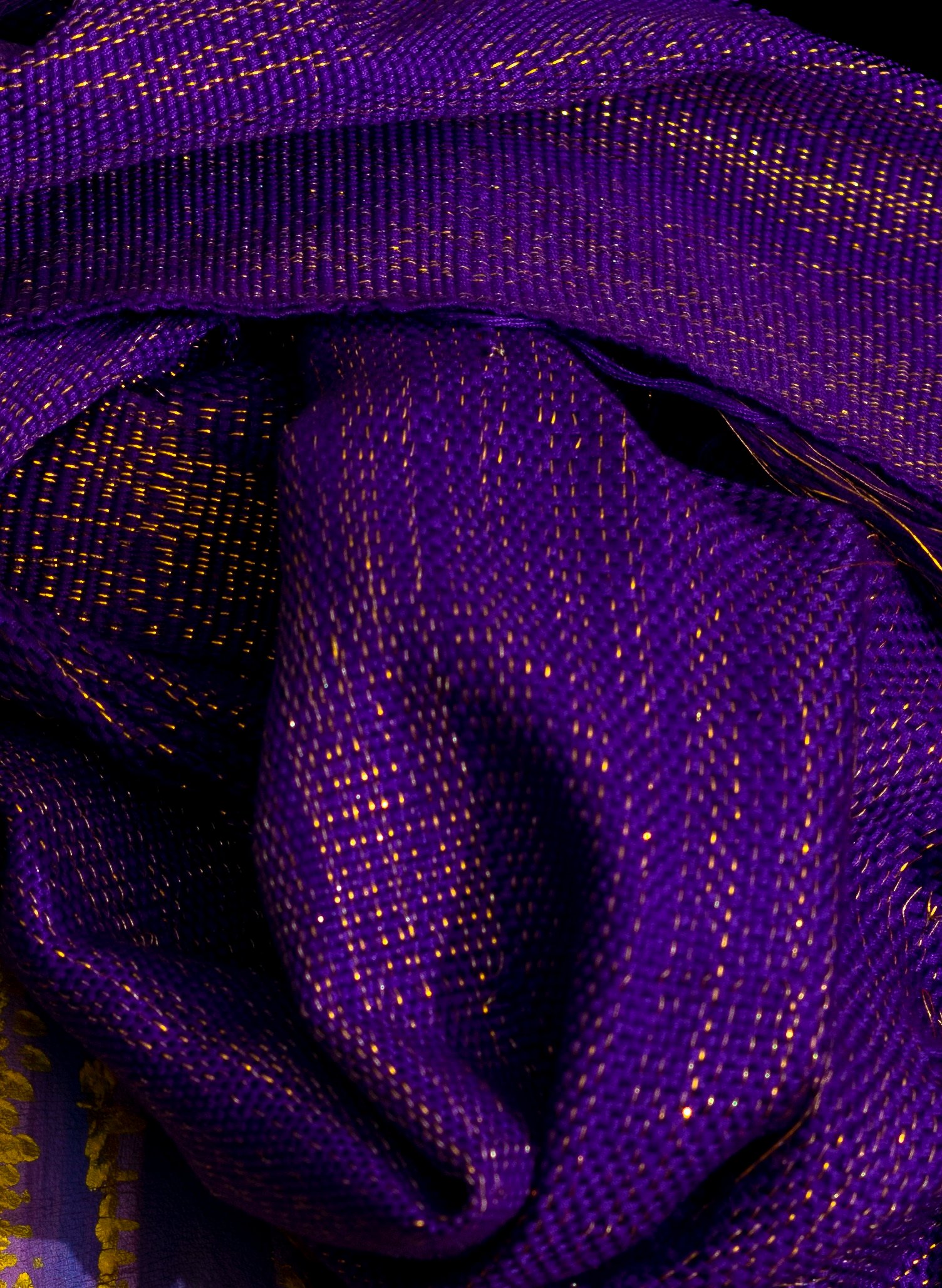
Walk into a Yoruba wedding or naming ceremony and you will notice the color coordination before anything else. Groups of guests wear the same fabric, cut into different silhouettes, so that a glance across the room tells you who belongs with whom. This is aso-ebi, and it is one of the most sophisticated dress systems in fashion. At its heart, often, is aso-oke, a hand-woven cloth with a history stretching back generations.
Aso-ebi: the family cloth
In Yoruba, aso means cloth and ebi means family, so aso-ebi translates as “family cloth.” A blog post published by the Victoria and Albert Museum in London ahead of its 2022 exhibition Africa Fashion, written by a member of staff who is also a designer of Nigerian heritage, describes it as a type of uniform dress that serves as a piece of identity, displaying unity among a group. It shows “who’s who,” especially at a traditional wedding or funeral, with the shared cloth identifying the immediate family and those who have gathered to support them.
The same essay calls aso-ebi “the haute couture of traditional uniform dress.” It is made to order, detailed and colorful, and its production is a collaboration among a designer, weaver, seamstress or tailor, embroidery designer and embroiderer. The writer compares the applied embroidery to the work of French embroidery houses such as Lesage.
The garments
The V&A essay lists the layers that make up a complete look.
For women:
- Iro, the wrap skirt, often simply called the wrapper.
- Gèlè, the head wrap, which can be tied in elaborate styles depending on the material.
- Buba, a blouse or top.
- Ipele, a shawl usually draped over the shoulder.
For men:
- Fila, a cap worn draped to one side or standing up.
- Sokoto, trousers, worn with a buba tunic.
- Agbada, a flowing outer gown ending between the knee and ankle.
- Kembe, three-quarter-length trousers, and dansiki, an oversized embroidered top, may also be worn.
Aso-oke: cloth from the countryside
Aso-ebi can be made from many fabrics, but it is often made from aso-oke. According to the V&A essay, the name is short for aso ilu oke, meaning clothes from the countryside, and the cloth has been woven by the Yoruba for centuries, predominantly in south-western Nigeria. The town of Iseyin is one of its best-known weaving centers, and it is also produced across several other states, including Oyo, Ogun, Ondo, Ekiti, Osun, Kwara, Kogi and Lagos.
The Saint Louis Art Museum in Missouri explored the cloth in its 2023 exhibition Aso Oke: Prestige Cloth from Nigeria, which presented textiles created by Yoruba weavers and fashioned into clothing for celebratory and ceremonial occasions from the early 19th to the late 20th century.
The three classic types
The museum describes three elemental types of aso-oke that form the foundation for every later innovation. Spellings vary from source to source; we use the museum’s.
- Sanyan. Undyed raw silk. The V&A essay calls it “the king of aso oke” and explains that it is woven from beige wild silk from the cocoons of the Anaphe moth, combined with cotton. It is left undyed to keep its natural light brown color.
- Alaari. Magenta-dyed silk. According to the V&A essay, it is woven with magenta waste silk, synthetic silk or local cotton, and sometimes features shiny threads or, more rarely, perforated patterns.
- Etu. Indigo-dyed, a deep blue often with very fine light-blue stripes, said to resemble the plumage of a bird. Historically, the V&A essay notes, etu was worn as social dress by chiefs and elders, while alaari could be worn for most Yoruba events.
Innovation at the loom
Aso-oke has never stood still. The Saint Louis exhibition showed mid-20th-century cloths demonstrating techniques such as ikat, openwork, carryover threads and mixed strip assemblage, with weft-float motifs ranging from geometric designs to lettered messages woven into the cloth. Late-20th-century cloths incorporated new materials, including Lurex and rayon, for a luminous effect that still referenced the three classic types.
That history of experiment is why aso-oke continues to appear in contemporary fashion and art. The same exhibition included work by the Nigerian artist Nengi Omuku, who paints in oil directly onto sanyan cloth collected from markets in Nigeria.
Notes for designers, stylists and guests
- Respect the system. Aso-ebi exists to show unity and support. If you are invited to wear it, wearing the chosen cloth is part of the celebration.
- Know what you are buying. Hand-woven aso-oke is a prestige cloth, and the Saint Louis exhibition showed how it is built from woven strips. Ask where and how it was woven.
- Use the right names. Sanyan, alaari and etu are distinct cloths with distinct associations. Using the right term is part of honoring the craft.
Read on: adire, kente, and Africa’s fashion weeks.
Find talent in the MOAM directory · Subscribe to The MOAM List · Follow MOAM on Instagram @moam_co and Facebook makingofamogul · Tips and corrections: hello@makingofamogul.com
Sources
- V&A Blog, “Africa Fashion: Aso-Ebi”
- Saint Louis Art Museum, Aso Oke: Prestige Cloth from Nigeria (exhibition, 2023)
Photo credits: “Détail de tissu Aso oke, Nigeria, collection privée de Ariane Mawaffo” by Rhodapenmarck, via Wikimedia Commons, CC0 (https://creativecommons.org/publicdomain/zero/1.0/deed.en)
Editor’s note: facts in this article were checked against the linked museum sources in October 2026.
Leave a Reply