New York, New York · Part 2 · Fashion
On Thursday, February 16, 2023,, a crowd of more than 150 people drank hot chocolate on Seventh Avenue at 39th Street and waited for a pair of giant scissors. Shortly after 11 a.m., the ribbon was cut on a new landmark: a button fifteen feet across, finished in the bright yellow of a New York taxi and pierced by a 32-foot needle of brushed stainless steel, with a mirror-polished thread looping down to hold it up. There had been a Big Button on this corner since 1996, when the Garment District Alliance put the first one, designed by James Biber, then of Pentagram, on top of an information kiosk. Structural damage meant the old one could not be saved; the new one stands half on the city sidewalk and half on the plaza of 1411 Broadway. (Garment District Alliance)
Look down and the district keeps talking. Since 1999, the Fashion Walk of Fame has set white bronze plaques in granite into the Seventh Avenue sidewalk, each with a designer’s sketch, signature and story. (Fashion Walk of Fame) A few steps away stands The Garment Worker, Judith Weller’s eight-foot bronze. (Commercial Observer) Buttons, needles and the people who push them: the street is a monument to making things.
From the Tenderloin to Fashion Avenue
It was not always so. Before the dress trade arrived, the blocks west of Herald Square belonged to the Tenderloin, a district of saloons and brothels that the Garment District Alliance’s own history calls the most infamous neighborhood in the country. (Garment District Alliance)
The apparel trade then lived downtown, on the Lower East Side and in the lofts around Washington Square. By 1910, the garment industry accounted for around forty-six percent of the city’s industrial labor force, much of it Eastern European Jewish immigrants. In 1909, workers walked out in the strike remembered as the Uprising of the 20,000. On March 25, 1911, a fire started on a cutting table on the eighth floor of the Triangle Shirtwaist Factory, on Greene Street, which employed around 600 people across the top three floors of its building. It became one of the most infamous industrial disasters in American history, and in the wake of the strike and the fire, new laws were passed to improve working conditions. (Garment District Alliance)
The move uptown was not only about space. The Fifth Avenue Association, formed by some of the city’s wealthiest merchants and property owners, wanted factories and their immigrant workers off the shopping avenue, and used boycotts and pressure on lenders to stop new lofts being financed there. (Garment District Alliance) The trade settled further west, around Seventh Avenue. In 1972, the stretch of Seventh Avenue through the district was given a second name: Fashion Avenue. (Wikipedia) In 2008, the Garment Center Historic District, between Sixth and Ninth Avenues and 35th and 41st Streets, was listed on the National Register of Historic Places, with 215 contributing buildings. (Wikipedia)
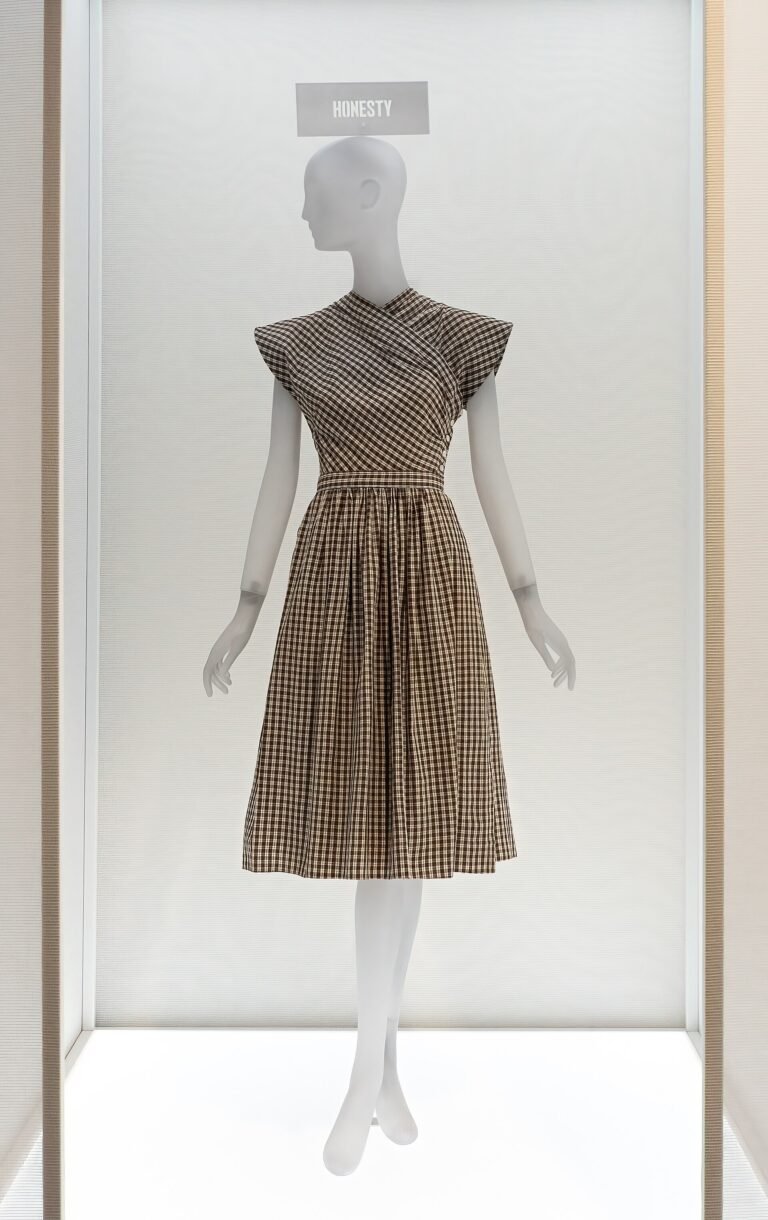
Those buildings did more than house sewing machines. When Claire McCardell designed her 1942 Popover, a wrap dress of durable cotton, she designed it so that it could be easily reproduced in the factories of New York’s Garment District. (The New York Historical) The American Look was cut, sewn and shipped from these blocks.
Zoning the trade
For decades the city tried to protect the district with zoning. A 1987 rule required owners in parts of the neighborhood to preserve industrial space at a one-to-one ratio when they converted manufacturing buildings to other uses. In December 2018, the City Council voted unanimously to lift it, while adding a special permit for new hotels in manufacturing zones. (Commercial Observer)
The bigger change came in 2025. On August 14, the Council approved the Midtown South Mixed-Use Plan, rezoning 42 blocks for roughly 9,500 new homes. The Council said it had secured more than $120 million in economic development resources for the fashion and garment industries, including a campaign called Midtown Made, a Local Production Fund to encourage designers to use local factories, and $50 million for a fund to help nonprofits secure permanent, below-market space for the trade. (New York City Council)
Advocates had warned of the stakes. Made in NYC noted that the city’s own Draft Environmental Impact Statement estimated that 114 garment businesses could be displaced. (Made in NYC) In the end, industry leaders won a carve-out that kept manufacturing zoning from West 35th to West 40th Street between Seventh and Eighth Avenues, the area home to 779 garment-related businesses and 5,300 employees, according to Commercial Observer. (Commercial Observer)
The ecosystem
Laura Weber, founder of LW Pearl Atelier, runs her embroidery studio on West 38th Street. Her work has gone to Gabriela Hearst, Proenza Schouler and Thom Browne, and she designed uniforms and jackets that Team Ireland wore at the Paris Olympics. She credits the address. (Commercial Observer)
There are entire businesses that only apply buttons and snaps, cut zippers, and make buttonholes. One business owns a service that in turn is an integral part of one garment.
Laura Weber, LW Pearl Atelier, to Commercial Observer
That is the Garment District in a sentence. It is not one factory but hundreds of specialists within walking distance of each other: the pleater, the button shop, the sample room, the patternmaker on the fourth floor. A designer can walk a fitting from one to the next before lunch.
What stays
The neighborhood is changing. Offices are being converted to apartments, and thousands more homes are planned. But the yellow button on Seventh Avenue is a promise in public art: that the city still wants the people who make clothes to work where clothes have always been made. Walk the plaques on Fashion Avenue and you will pass the names in this series, Halston, Claire McCardell, Willi Smith and Stephen Burrows among them, set in granite outside the buildings where their ideas became garments.
Sources
- Garment District Alliance, “Button & Needle Sculpture”
- Garment District Alliance, “History”
- Fashion Center BID, “Fashion Walk of Fame” (archived 2012)
- Commercial Observer, “City Council Approves Garment District Rezoning” (Dec 20, 2018)
- Commercial Observer, “Manhattan’s Garment District Confronts Stark Challenge After Big Rezoning” (Oct 27, 2025)
- New York City Council, press release on approval of the Midtown South Mixed-Use Plan (Aug 14, 2025)
- Made in NYC, “Take Action on the Midtown South Rezoning to Protect Garment Manufacturing”
- The New York Historical, “Rationing Fashion: Claire McCardell’s Wartime Innovation”
- Wikipedia, “Garment District, Manhattan”
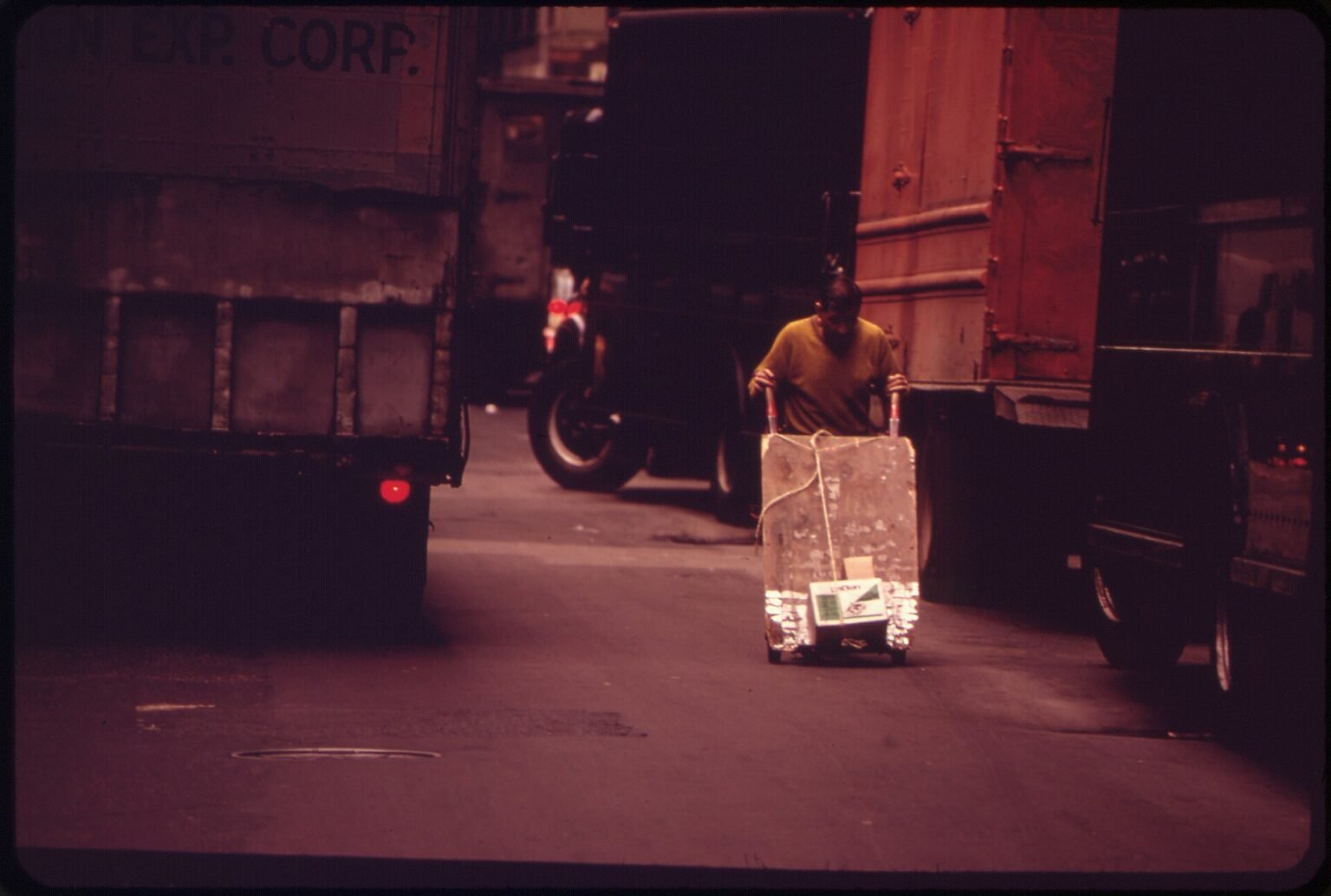
Photo: “MANHATTAN’S GARMENT DISTRICT ON SEVENTH AVENUE – NARA – 549850” by Dan McCoy, Public domain, via Wikimedia Commons.
Editor’s note: facts in this article were checked against the linked sources in November 2026. The Big Button details (February 16, 2023 ribbon-cutting, the 1996 original by James Biber, dimensions and finishes, the 1411 Broadway plaza) are from the Garment District Alliance. The Fashion Walk of Fame’s 1999 founding and plaque description are from the Fashion Center BID’s archived page; the BID has since been renamed the Garment District Alliance, and the honorees named in the closing paragraph are listed on that page. Judith Weller’s sculpture is described from a Commercial Observer photo caption. The Tenderloin, labor force share, 1909 strike, Triangle fire details and the Fifth Avenue Association’s campaign come from the Garment District Alliance’s history page and are attributed to it. The 1972 Fashion Avenue designation and the 2008 National Register listing are from Wikipedia. The 2018 zoning vote is from Commercial Observer; the 2025 plan figures, the Council’s August 14, 2025 approval and the funding programs are from the Council’s press releases; the 114-business displacement estimate is Made in NYC’s summary of the city’s Draft Environmental Impact Statement; the carve-out boundaries and the 779 businesses and 5,300 employees are from Commercial Observer (October 27, 2025). Laura Weber’s quote is from that article. The featured photograph is from April 1973 and does not show the present-day district.