New York, New York · Part 5 · Fashion
Through the marble lobby of 641 Fifth Avenue, up to the twenty-first floor and past an unmarked door, Halston built a headquarters that looked like the inside of a jewel. The ceilings rose eighteen feet. The outer walls were glass, framing the Manhattan skyline, and every interior partition was covered in mirror, so the view and the people in it reflected without end. There were white orchids everywhere, and tableware designed by his friend Elsa Peretti. Olympic Tower, the 51-story Skidmore, Owings & Merrill building across from St. Patrick’s Cathedral, became his stage in 1978. (PIN–UP)
PIN–UP magazine called him the “master of minimalism.” Andy Warhol, in a 1979 book, called him the “first All-American fashion designer.” (PIN–UP; The Andy Warhol Museum) Both were describing a man who had arrived in New York to make hats.
The hat
Roy Halston Frowick was born in Des Moines, Iowa, on April 23, 1932. He came to New York as a milliner, became co-designer at Lilly Daché and then head milliner at Bergdorf Goodman. (Wikipedia) In January 1961, Jacqueline Kennedy wore his pillbox hat to her husband’s presidential inauguration, and Halston’s profile, as the Warhol Museum puts it, “was immediately elevated.” (The Andy Warhol Museum)
Bergdorf introduced his first clothing collection in 1966. In 1968 he opened his own boutique on Madison Avenue, and the clients came: Greta Garbo, Babe Paley, Lauren Bacall, Elizabeth Taylor, Bianca Jagger, Liza Minnelli. (Wikipedia)
The shirtdress
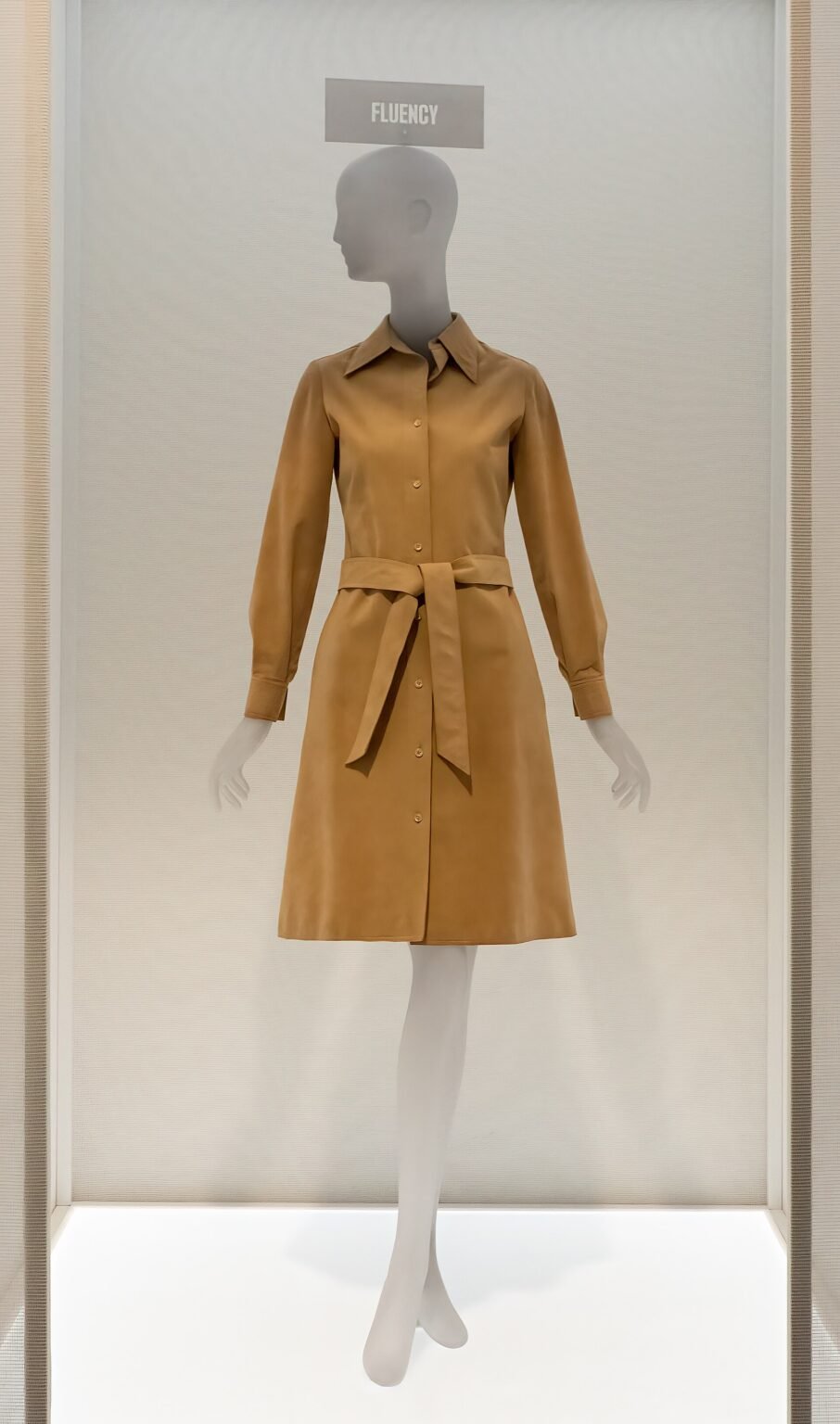
The breakthrough fabric came from Paris. In 1971, Halston saw Issey Miyake wearing one of his own designs in a new microfiber called Ultrasuede. Halston thought it was waterproof and made a trench coat from it, which absorbed water instead. The Museum at FIT calls it “a happy accident.” (The Museum at FIT) Soon after, in fall 1972, he introduced a shirtwaist dress in Ultrasuede, model number 704: a subtle adaptation of a man’s shirt, machine washable, with buttons that began at the breastbone rather than the neckline. (The Museum at FIT)
The dress said everything about his method. Halston, the Warhol Museum writes, “intuitively understood the properties of both natural and man-made fabrics,” and Ultrasuede went on to appear in his suits, eveningwear, Braniff International Airways uniforms, bedspreads and luggage. (The Andy Warhol Museum) His line, by one estimate, earned $30 million between 1968 and 1973. (Wikipedia)
The ’70s belonged to Halston.
Fashion Walk of Fame, Seventh Avenue
The city at night, and at home
Halston dressed the decade he defined. His friends filled his front rows: Lee Radziwill, Martha Graham, Liza Minnelli, Elizabeth Taylor, Diana Vreeland, Andy Warhol and Steve Rubell of Studio 54. (Wikipedia) His models, the Halstonettes, became stars in their own right. (Wikipedia) In 1977 he designed Minnelli’s costumes for the Broadway show The Act, and he made costumes for Martha Graham’s ballets, including Clytemnestra in 1978. (Wikipedia)
His reach went well past the runway. He was asked to design uniforms for the U.S. team at the 1976 Pan American Games and Olympics, and in March 1977 he hosted a benefit for the Martha Graham Dance Company at Bergdorf Goodman. (Wikipedia) In 2015, the Museum at FIT paired him with Yves Saint Laurent in Yves Saint Laurent + Halston: Fashioning the 70s, noting the “choice of unisex elements” that became the foundation of his daytime designs for women. (The Museum at FIT)
At home, he lived in a townhouse at 101 East 63rd Street designed by Paul Rudolph, an example, PIN–UP wrote, of the architect’s “patrician Modernism.” (PIN–UP) He hung Warhol’s work there, and summered in a Montauk house he rented from Warhol. (The Andy Warhol Museum)
The name
In 1973, Halston sold his company, including his name, to the conglomerate Norton Simon, Inc. That same year he showed in Paris at the Battle of Versailles, the Franco-American fashion show staged to benefit the restoration of the palace. (Wikipedia; PIN–UP) The deal financed his rise to Olympic Tower. It also meant he did not own what he had built.
In 1983 he signed a licensing deal with J.C. Penney, the mall chain, for a mass-market line. Bergdorf Goodman, a supporter since his hat days, dropped his collection. The same year Norton Simon was sold to Esmark, whose executives were astonished by the spending at Olympic Tower. In 1984, PIN–UP reports, they locked him out, and John David Ridge took over designing the lines. (PIN–UP; Wikipedia)
Halston died on March 26, 1990, at fifty-seven, of AIDS-related cancer. (Wikipedia)
What he left
Halston’s New York was Madison Avenue by day, the dance floor by night and a mirrored office on Fifth Avenue in between. He made the case that American fashion could be as glamorous as Paris by being simpler: a man’s shirt recut for a woman, a washable fabric treated like suede, an office that was also a stage. Minimalism is still the city’s favorite uniform. Halston made it look like luxury.
Sources
- PIN–UP, “Hall of Mirrors: Halston’s Rise and Fall and the Link to New York’s Olympic Tower”
- The Andy Warhol Museum, “Halston and Warhol: Silver and Suede”
- The Museum at FIT, “Menswear: Halston + Ultrasuede” (Yves Saint Laurent + Halston: Fashioning the 70s, 2015)
- Wikipedia, “Halston”
- Fashion Center BID, “Fashion Walk of Fame” (archived 2012)
Photo: “Halston dress at the Met (52698)” by Rhododendrites, CC BY-SA 4.0, via Wikimedia Commons.
Editor’s note: facts in this article were checked against the linked sources in November 2026. The Olympic Tower description, Peretti tableware, the East 63rd Street townhouse, the Norton Simon sale, the J.C. Penney fallout, Esmark and the 1984 lockout are from PIN–UP’s essay; the essay gives 1977 as the year the company outgrew its East 68th Street space and pictures the Olympic Tower showroom in 1978, while Wikipedia dates the move to 1978. Warhol’s “first All-American fashion designer,” the pillbox hat, the Montauk rental and the Ultrasuede uses are from the Andy Warhol Museum. The Ultrasuede origin story and the 704 shirtwaist are from the Museum at FIT. Halston’s birth, career steps, clients, Versailles, the $30 million estimate (attributed), the front row, the Halstonettes, The Act, Martha Graham, John David Ridge and his death are from Wikipedia. The Fashion Walk of Fame line is from the BID’s archived page. The 1976 uniforms, the 1977 benefit and the 2015 FIT exhibition are from Wikipedia and the Museum at FIT. The closing paragraph is the writer’s assessment. The featured image is a museum display photographed in 2022; the dress is not identified as Ultrasuede in its record.