New York, New York · Part 3 · Fashion
The bride walked out in Newport, Rhode Island, on September 12, 1953, in fifty yards of ivory silk taffeta, with a bodice of interwoven bands of tucking, and more tucking swept in great circles around a full skirt. (Vanity Fair; Wikipedia) She was Jacqueline Bouvier, marrying Senator John F. Kennedy. Almost no one in the pews could have named the woman who made the dress in New York, twice.
Her name was Ann Lowe. Weeks before the wedding, after two months of work, a flood in her studio destroyed the gown and the bridesmaids’ dresses. Lowe remade the collection, by Vanity Fair’s account, in about ten days, without telling her clients. (Vanity Fair) Accounts differ on exactly when the water came; Vanity Fair puts it two weeks before the ceremony. What does not differ is the outcome. The dress was ready on the day, and it is still the work Lowe is best known for.
Alabama to Manhattan
Lowe was born in Alabama around 1898; her self-reported birth date never quite matched the census, as the curator Elizabeth Way has noted. She was the daughter and granddaughter of dressmakers, and she started sewing scraps into fabric flowers as early as age five. (WWD) Her grandmother had been enslaved. (Vanity Fair)
A Tampa family, the Lees, whose money came from citrus, supported her studies at a dressmaking school in Manhattan. (WWD) When she arrived at S. T. Taylor Design School in 1917, Way told Elle, the administration did not know she was Black until the first day, and seated her in a separate classroom. Her teacher began carrying her work in to show the other students, who were soon “hovering at the door.” She graduated in half the time. “I think one of the ways she dealt with discrimination was by being the best,” Way said. (Elle) She went back to Florida, built a business, and in 1928 returned to New York with savings and, in WWD’s words, “a mindset to make it, whatever the odds.” (WWD; Wikipedia)
Couture, not Seventh Avenue
In New York, Lowe designed at different times for Neiman Marcus, Saks Fifth Avenue and her own business, and her clients soon came straight out of the Social Register. (WWD) In the 1930s she lived on Manhattan Avenue in Harlem. In 1950, with her son, she opened Ann Lowe’s Gowns on Lexington Avenue, and in 1968 she opened Ann Lowe Originals on Madison Avenue. Over her career she dressed the Auchinclosses, Rockefellers, Roosevelts, du Ponts, Whitneys and Biddles. (Wikipedia)
She was proud of it. “I do not cater to Mary and Sue,” she once said of her clientele, a line Elle quoted in 2023. (Elle) And she worked the old way. Way, who wrote the book on Lowe and guest-curated her retrospective, put the point plainly.
It wasn’t all ready-to-wear coming from Seventh Avenue; she was making couture in the same ways they were making it in France.
Elizabeth Way, to WWD
Lowe built her dresses from the inside out, Way explained, in the nineteenth-century manner: the internal structure first, bras and bodices built in, then layer upon layer outward, finished with beading, appliqué and the three-dimensional fabric flowers that became her signature. (WWD) Alexandra Deutsch, Winterthur’s director of collections, said her “meticulous handwork and sculptural fabric flowers” made the gowns “instantly recognizable status symbols for society women.” (Elle)
The Bouvier commissions
The Kennedy wedding was not her first Bouvier job. In 1947, Janet Lee Auchincloss commissioned Lowe to make debutante gowns for her daughters Jacqueline and Lee. Six years later she came back for the wedding dress and the bridal party. (Wikipedia) Lowe’s name did not travel with the photographs. In one publication, Way says, she was referred to as “a colored woman dressmaker.” Lowe wrote to Jacqueline Kennedy’s press secretary to say she was displeased, and received an apology saying Mrs. Kennedy had not approved the quotes. (Elle) WWD quotes another letter, in which Lowe wrote of “how hurt I feel as a result of an article.” (WWD) Vanity Fair describes how her name was lost to history for decades. (Vanity Fair)
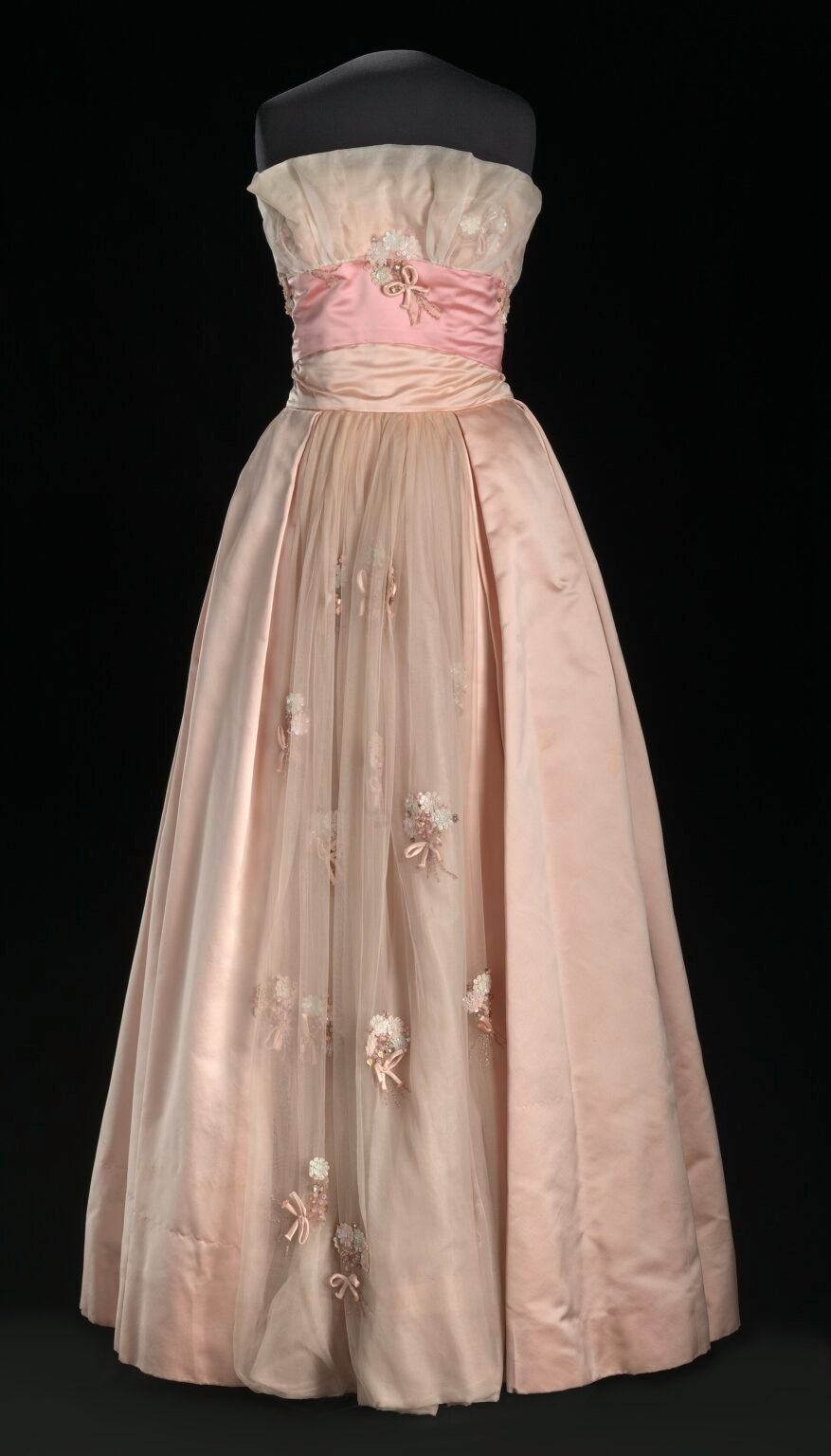
The gowns that survive tell the rest. The Smithsonian’s National Museum of African American History and Culture holds a 1959 evening dress by Lowe, worn by Patricia Schieffer: a strapless pale bodice over a full skirt scattered with fabric flowers. (Wikimedia Commons / NMAAHC)
The retrospective
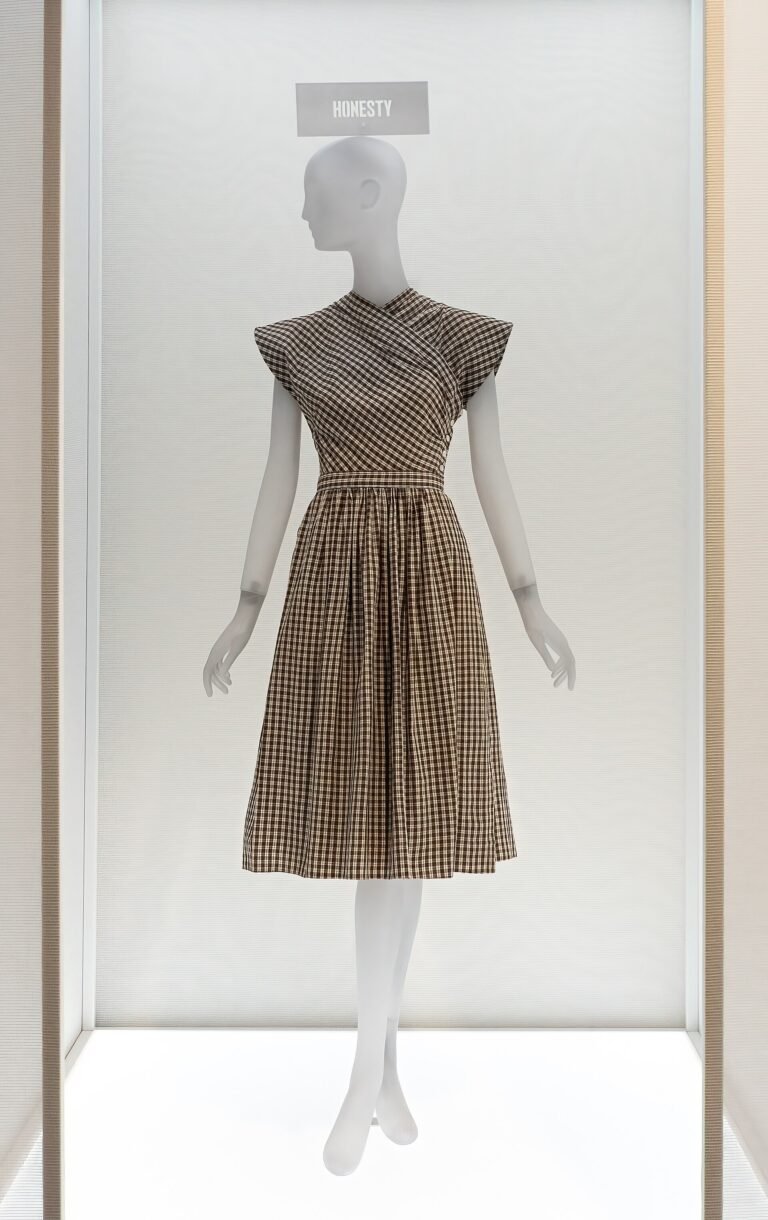
From September 2023 to January 2024, the Winterthur Museum, Garden & Library in Delaware mounted Ann Lowe: American Couturier, the largest exhibition of her work to date: forty gowns, many never shown in public, tracing her evolution from the 1920s to the 1960s, alongside contemporary designers working in her legacy. (Winterthur; Wikipedia) Before it opened, Way said, word went out to find uncatalogued Lowe dresses, and people answered: “I have a picture, I have a dress, I have a story.” The Kennedy gown itself was too fragile to travel, so Katya Roelse, an instructor in the University of Delaware’s fashion department, recreated it with conservators and students, a project Way estimates took around six months. (Elle)
Lowe died on February 25, 1981. (Wikipedia) Her New York was a city of Lexington and Madison Avenue salons, Harlem apartments and Fifth Avenue department stores, of debutante seasons and Newport weddings. She worked inside it on her own terms, and her flowers still bloom on museum mannequins, finally under her own name.
Sources
- Vanity Fair, Fawnia Soo Hoo, “The Powerful Story Behind Jackie Kennedy’s Wedding Dress” (Jan 18, 2023)
- WWD, Tara Donaldson, “This Biggest-ever Ann Lowe Exhibit Is Set to Shine a Light on the Long Under-credited American Designer” (Sept 5, 2023)
- Elle, “Ann Lowe Was ‘Society’s Best-Kept Secret.’ This Exhibit Aims to Make Her a Household Name.” (Sept 8, 2023)
- Winterthur Museum, Garden & Library, “Ann Lowe: American Couturier”
- Wikipedia, “Ann Lowe”
- Wikimedia Commons, NMAAHC, “Dress designed by Ann Lowe” (2007.3.20)
Photo: “Smithsonian – NMAAHC – Dress designed by Ann Lowe – 2007.3.20 001” (National Museum of African American History and Culture, Smithsonian), CC0 1.0, Public domain, via Wikimedia Commons.
Editor’s note: facts in this article were checked against the linked sources in November 2026. The wedding date, the flood, the remaking of the dresses and the “two weeks” timing are from Vanity Fair (2023); Wikipedia’s entry dates the flood to ten days before the wedding, so the article attributes the timing and notes that accounts differ. The fabric yardage and the description of the tucking are quoted in Wikipedia’s entry. Lowe’s birth year is given as “around 1898” because WWD reports that her self-reported date did not match census data; Wikipedia gives December 14, 1898. Her schooling, the Lee family’s support, her Saks and Neiman Marcus work and Way’s quotations are from WWD (2023); the segregated classroom, Harlem address, the Lexington and Madison Avenue salons, the client families, the 1947 debutante commission and her death date are from Wikipedia. The “Mary and Sue” quote and Alexandra Deutsch’s remarks are as quoted in Elle (2023). The Winterthur exhibition details are from the museum’s page and Wikipedia. The NMAAHC dress description is based on the museum’s photograph and its Commons record. “Society’s Best-Kept Secret” is the phrase Elle used in its 2023 headline. The featured image is a museum object photograph, not the Kennedy wedding dress.