
American fashion history has often been told through a short list of names. Museums have spent the last two decades widening it. Three designers in particular, Ann Lowe, Willi Smith and Patrick Kelly, now have major exhibitions and collections devoted to them. None of them is alive to tell their story, so their work and the archives have to do it. Here is what the record shows.
Ann Lowe (about 1898 to 1981): the couturier behind the famous gown
Ann Lowe was born in Clayton, Alabama, into a family of dressmakers, and trained under her mother and grandmother, according to the Smithsonian’s National Museum of African American History and Culture and Winterthur Museum. She built a career dressing society clients and, as both institutions note, became the first African American to run a couture salon on Madison Avenue. After closing her own salon in 1960 she worked for Saks Fifth Avenue’s Adam Room until 1962.
Her best-known commission is also the clearest example of how her name was left out. Lowe designed Jacqueline Bouvier’s 1953 wedding gown and the bridal party’s dresses for her marriage to John F. Kennedy. The gown is now held by the John F. Kennedy Presidential Library and Museum, while NMAAHC holds a significant collection of other Lowe garments.
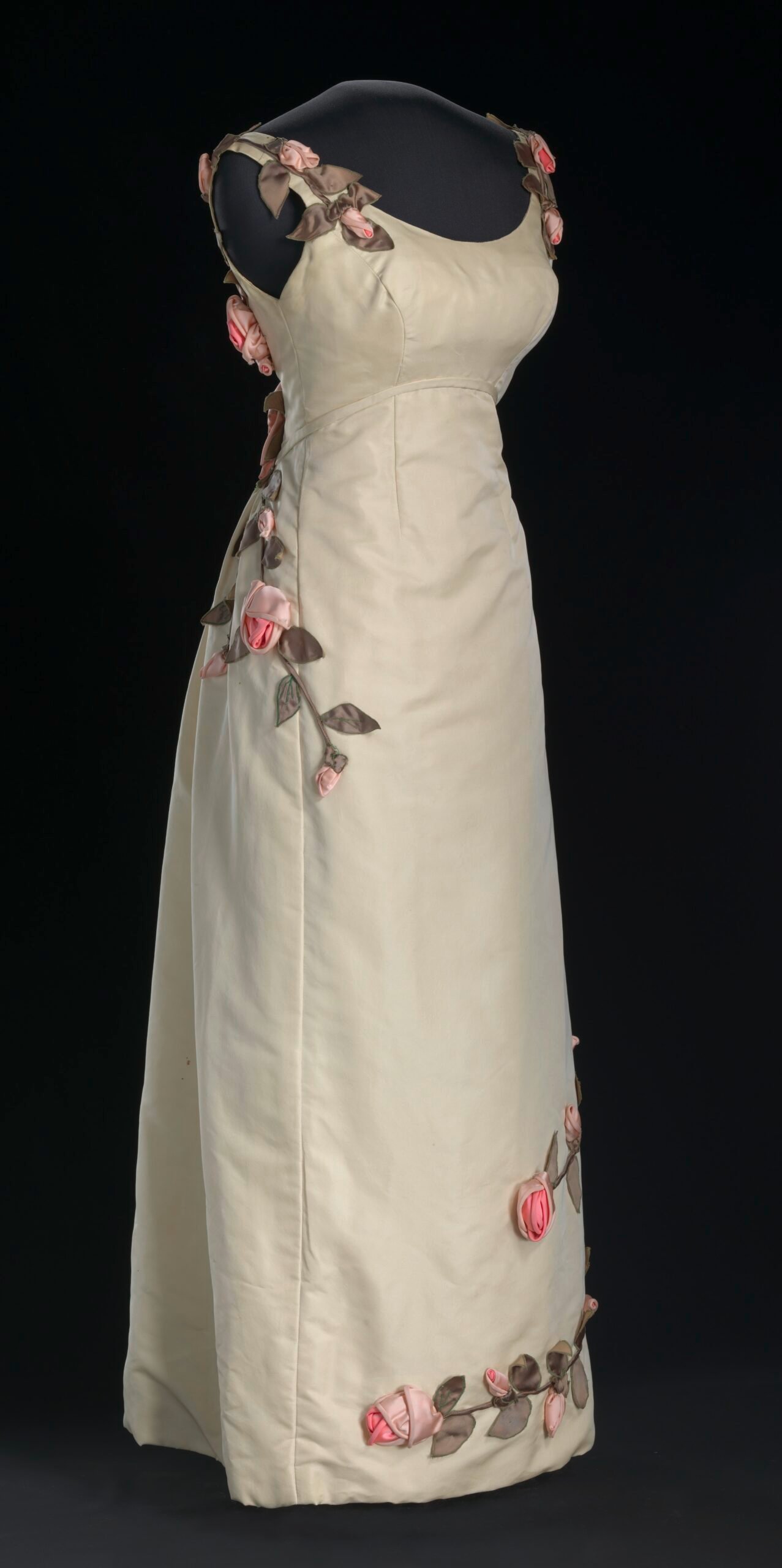
In 2023, Winterthur Museum in Delaware mounted Ann Lowe: American Couturier, which ran from September 9, 2023 to January 7, 2024 and brought together roughly 40 of her gowns. Our featured image is one of the Lowe dresses NMAAHC has released into the public domain.
Willi Smith (1948 to 1987): the inventor of “street couture”
Willi Donnell Smith was born on February 29, 1948, in Philadelphia, to an ironworker father and a mother who was an artist and homemaker. The timeline published by Cooper Hewitt, Smithsonian Design Museum, follows him to a fashion-illustration class at the Philadelphia Museum College of Art and then, in 1965, to New York, where he enrolled at Parsons School of Design on two scholarships while apprenticing with couturier Arnold Scaasi.
In 1976 Smith and Laurie Mallet formed WilliWear Ltd., with Mallet as president and Smith as vice president and lead designer. Its first showroom was at 32 West 39th Street, in the Garment District. Cooper Hewitt describes what came next as a fusion of affordable, adaptable clothing with avant-garde art, film, dance and design:
- In 1983 Smith won the Coty American Fashion Critics’ award for womenswear, and WilliWear launched a division selling mass-produced clothing designed by artists.
- He designed workers’ uniforms for Christo and Jeanne-Claude’s Pont Neuf Wrapped in Paris in 1985.
- That year WilliWear presented its Spring 1986 collection through a film, Expedition, shot in Senegal and premiered at the Ziegfeld Theatre during New York Fashion Week.
- In 1986, according to the museum, WilliWear grossed more than $25 million.
Smith died on April 17, 1987, of AIDS-related complications, at 39. Cooper Hewitt says that at his death he was considered “the most commercially successful Black American designer of the 20th century” and a pioneer of “street couture.” Its exhibition Willi Smith: Street Couture ran from March 2020 to October 2021, and its online version remains one of the richest free resources on any American designer.
Patrick Kelly (1954 to 1990): Mississippi to the Louvre
Patrick Kelly was born in Vicksburg, Mississippi, on September 24, 1954. The Mississippi Encyclopedia records that he was raised largely by his mother, a home economics teacher, and his grandmother, and that he was making dresses for neighborhood girls while still in high school. He studied at Jackson State University, moved to Atlanta, briefly attended Parsons in New York and, in 1979, moved to Paris.
There, his body-hugging jersey dresses covered in colorful buttons, a habit the encyclopedia traces to his grandmother, made his name. He founded Patrick Kelly Paris in 1986 with his partner Bjorn Amelan. In 1988 he became the first American and the first Black designer admitted to the Chambre Syndicale du Prêt-à-Porter des Couturiers et des Créateurs de Mode, the French ready-to-wear body, and showed his collection at the Louvre.
His work was joyful and also provocative. He collected thousands of objects of Black memorabilia, including racist caricatures, and some of the imagery he used drew controversy. The Brooklyn Museum’s 2004 retrospective displayed that collection alongside his clothes, and the Philadelphia Museum of Art’s 2014 exhibition Patrick Kelly: Runway of Love did the same. Kelly died in Paris on January 1, 1990, of complications of AIDS. His designs appear in the Museum at FIT’s current exhibition, Doll Dressing, through January 3, 2027.
Why these stories matter now
All three worked inside the system. Lowe sold through society networks and a Fifth Avenue store, Smith through Seventh Avenue showrooms and department stores, Kelly through the French trade federation itself. Each succeeded commercially and was still under-credited for years. The museum work that has restored their names is a reminder to document your own: keep your sketches, your credits, your press and your sales records. Archives are how designers outlast the season.
See their work in person: start with the Museum at FIT, and read how New York became a fashion capital.
Find talent in the MOAM directory · Subscribe to The MOAM List · Follow MOAM on Instagram @moam_co and Facebook makingofamogul · Tips and corrections: hello@makingofamogul.com
Sources
- Smithsonian NMAAHC, Ann Lowe
- Smithsonian NMAAHC, Ann Lowe: Fashion Icon
- Winterthur Museum, Ann Lowe: American Couturier
- JFK Library, Jacqueline Bouvier’s Wedding Dress
- The Met, Ann Lowe (ca. 1898-1981) essay
- Cooper Hewitt, Willi Smith Street Couture: Beginnings and Career (timeline)
- Cooper Hewitt, About Willi Smith
- Cooper Hewitt, Willi Smith: Street Couture exhibition
- Mississippi Encyclopedia, Patrick Kelly
- Philadelphia Museum of Art, Patrick Kelly: Runway of Love
- The Museum at FIT, Exhibitions (Doll Dressing)
Photo credits: “Smithsonian – NMAAHC – Dress designed by Ann Lowe- NMAAHC 2007.3.19” by National Museum of African American History and Culture, Smithsonian Institution, via Wikimedia Commons, CC0 (https://creativecommons.org/publicdomain/zero/1.0/deed.en)
Editor’s note: facts in this article were checked against the linked museum and encyclopedia sources in October 2026. All three designers are deceased; no quotes are attributed to them. Exhibition dates are historical except Doll Dressing (through January 3, 2027).
Leave a Reply