
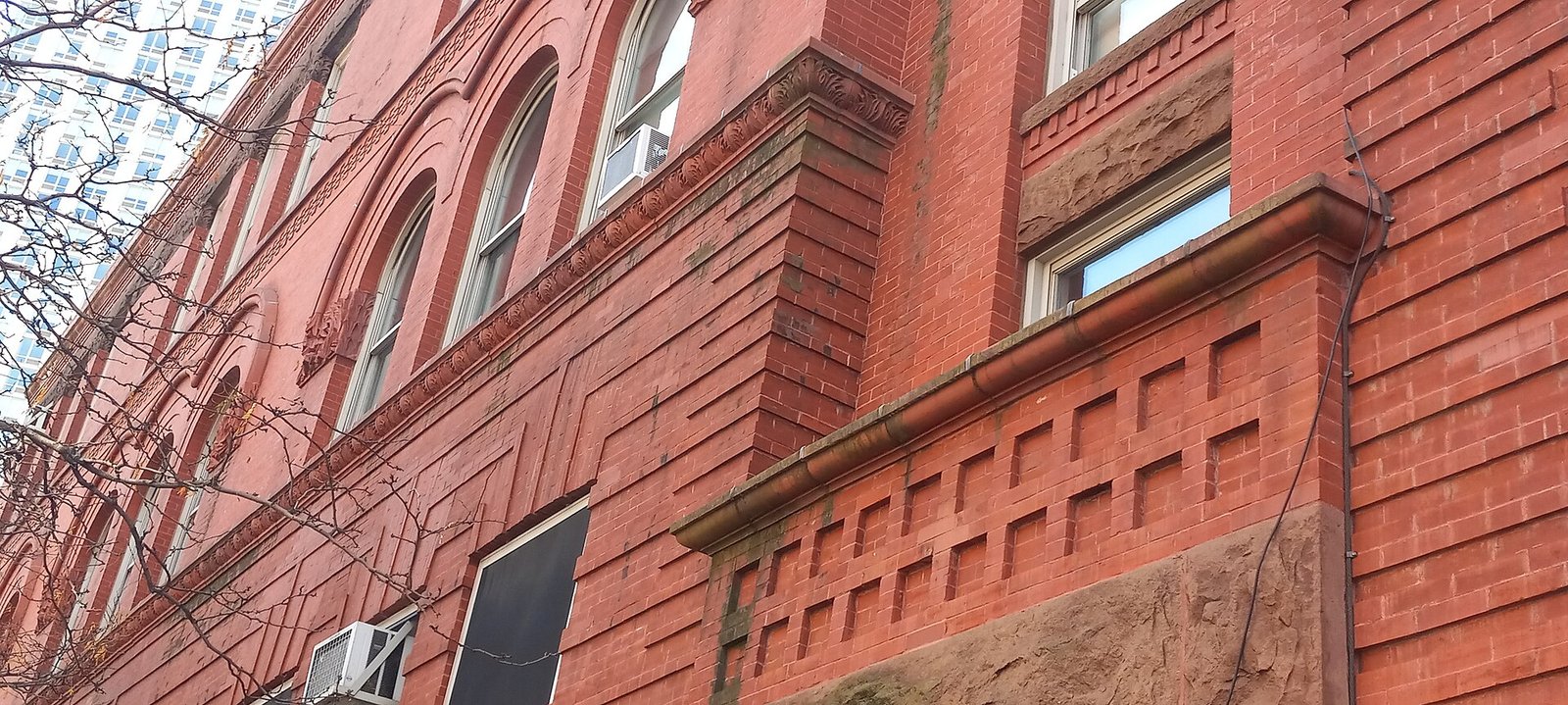
Long before fashion exhibitions drew lines around museum blocks, a former public schoolhouse in Long Island City was treating clothes as art. Between 1980 and 1984, PS1 staged ten fashion exhibitions in which garments were pinned to walls, casually arranged on pedestals, stuffed and hung salon-style, or stiffened in plaster and laid on the floor. None of it was a sales presentation. That was the point.
This fall the museum, now MoMA PS1, turns that history into an exhibition of its own. New York Fashion at PS1, 1980–1984 opens on November 5, 2026, and runs through March 15, 2027, as part of the institution’s 50th anniversary year.
The stylist behind the program
The program’s guiding figure was Hollywood Di Russo (1946–2005), a stylist, make-up artist and independent curator who, according to the museum, wanted to highlight fashion’s influence on visual culture and the arts, outside the commercial realm and the formal conventions of costume display. Her premise, as the press release puts it, was that fashion “undeniably influences the way that we see.”
She put it more personally to GQ in 1981, in words the museum quotes today: “I want to explore… the idea of fashion making us feel things: important or silly, handsome or sexy… We’re training our eyes to be more yielding, our hearts to be more receptive.”
The fashion shows were one strand of PS1’s wider Multi-Disciplinary Program, which also spanned sound, performance, poetry, film and architecture. That context matters. In a building founded in 1976 as a center of New York’s alternative-space movement, clothes were shown in the same spirit as experimental art, and the museum now describes the program as one of the earliest institutional meetings of contemporary art and fashion.
Seventh Avenue meets the avant-garde
The press release describes the participants as a mix of Seventh Avenue stalwarts prominent in the disco era, pioneering fashion videographers, assistants to legendary couturiers and the New York wing of the deconstructionist avant-garde. The published chronology reads like a cross-section of the city in those years:
Ronald Kolodzie opened the program in the fall of 1980, followed that winter by Julio Espada, who was born in Puerto Rico. In 1981 came Adrienne Scott’s Fashion Video and Homer Layne’s Collection of Charles James Fashions. Willi Smith’s Art as Damaged Goods ran in early 1982, and Lloyd Allen’s The Faux Beast that fall. Betsey Johnson showed in early 1983, and Gary Cathey’s Straight White Male followed that autumn. In 1984 came the Malaysian-born designer Yeohlee Teng, in a show organized by Richard Flood, and Valborg Fletre Linn’s Painted Fashions, by the Norwegian-born designer.
The range is the story. Designers born in Puerto Rico, Malaysia and Norway shared walls with names from Tennessee, Connecticut and Louisiana, and with a couturier, Charles James, whose work was shown through a private collection. All of it was in Queens, in a museum that did not ask anyone to sell anything.
What you will see
The new exhibition is organized by Kari Rittenbach, assistant curator at MoMA PS1. It draws on notes, correspondence, photographs and ephemera from the PS1 archives and private collections, and it includes original objects and partial reconstructions of the installations by Julio, Homer Layne and Charles James, Willi Smith and Betsey Johnson.
Two films anchor the show. The first compiles a sprawling conversation and more than 20 hours of footage of Charles James in his studio at the Chelsea Hotel, shot by Anton Perich and R. Couri Hay in 1978. The second is Made in New York, a rarely screened 1984 WilliWear production by Les Levine, with cameos by Willi Smith, Bill T. Jones and Arnie Zane, Jenny Holzer and Arman, among others.
Archival photographs fill in the wider picture: the growing influence of style in the 1980s, and, in the museum’s words, novel approaches to men’s and women’s wear in response to changing gender norms and the newly integrated workplaces of corporate America.
Why it matters now
New York now has no shortage of fashion in its museums, from the Costume Institute to the Museum at FIT. This exhibition is a reminder that some early experiments happened far from Fifth Avenue, in Queens, and that the press release counts emerging and experimental designers among those who took part. For anyone building a label in the city now, the lesson is that a show does not need to be a sales event to change how people see clothes.
It is also a chance to see Willi Smith (1948–1987) in his own context. His 1982 PS1 show carried the title Art as Damaged Goods, and the WilliWear film Made in New York puts him on screen alongside the choreographers Bill T. Jones and Arnie Zane and the artists Jenny Holzer and Arman. Seen together, the two suggest how closely the downtown art world and the city’s fashion designers moved in those years, which is exactly the relationship the exhibition sets out to trace.
Plan your visit
MoMA PS1 is at 22-25 Jackson Avenue at 46th Avenue in Long Island City, across the Queensboro Bridge from Midtown. Take the E, F or 7 to Court Square, or the G to Court Square or 21 St–Van Alst. According to the museum, admission is free, made possible by Sonya Yu, and tickets can be reserved online.
The opening weekend includes a public program. On Saturday, November 7, 2026, at 2 p.m., the Paris-based cultural theorist Marco Pecorari will discuss the significance of museum exhibitions for fashion designers in the late 20th century, followed by a conversation with the New York fashion critic Matthew Linde and the curator, Kari Rittenbach. Check the museum’s site for times and reservations before you go.
Read on: Willi Smith’s place in American fashion in Ann Lowe, Willi Smith, Patrick Kelly, and the city’s creative boroughs in Uptown, Across the River.
Find talent in the MOAM directory · Subscribe to The MOAM List · Follow MOAM on Instagram @moam_co and Facebook makingofamogul · Tips and corrections: hello@makingofamogul.com
Sources
- MoMA PS1, “New York Fashion at PS1, 1980–1984” (exhibition page)
- MoMA PS1, press release: “Archival Exhibition Traces the History of Fashion at PS1, Marking the Museum’s 50th Anniversary” (Sept 15, 2026)
Photo: “MoMA PS1 029” by Kidfly182, CC BY 4.0, via Wikimedia Commons.
Editor’s note: facts in this article were checked against the linked sources in October 2026. Hollywood Di Russo’s words are quoted as published by MoMA PS1; the program chronology, designers, films and visitor information come from the museum’s exhibition page and press release. The press release spells one designer’s name both “Fletre” and “Feltre”; we have used “Fletre,” from its list of participants. Hours and ticketing can change, so check the museum’s site before visiting. The featured photograph shows the museum building in 2024, not the exhibition.
Leave a Reply