Just off the Great Hall at the Metropolitan Museum of Art, fashion now greets visitors at the front door. Costume Art, the Costume Institute’s spring 2026 exhibition, is the inaugural show in the museum’s new, nearly 12,000-square-foot Condé M. Nast Galleries. It opened on May 10, 2026, and remains on view through January 10, 2027, in Gallery 099 at The Met Fifth Avenue.
The title has caused some confusion, as The Art Newspaper noted when the show opened. This is not a history of costumes for the stage or the screen, and it is not a straightforward survey of fashion inspired by painting. It is an argument about the dressed body — and about what happens when you look at the museum’s art through the clothes, rather than the other way around.
A new front door for fashion
The galleries sit adjacent to the Great Hall, a placement the museum describes as a new public threshold for the Costume Institute’s annual spring exhibition and, at times, for shows from other departments. They are named for Condé Nast’s late founder, in recognition of a lead gift from the company. The Brooklyn-based architecture firm Peterson Rich Office — Miriam Peterson and Nathan Rich — designed both the galleries and the exhibition.
Andrew Bolton, Curator in Charge of the Costume Institute, organized the show with Stephanie Kramer, senior research associate, and the research associates Ayaka Iida and Emily Mushaben. In the museum’s February press release, Bolton said he wanted to focus on “the centrality of the dressed body within the Museum,” and to connect “artistic representations of the body with fashion as an embodied art form.” Rather than privileging fashion’s visuality “at the expense of the corporeal,” he said, the exhibition “privileges its materiality and the indivisible connection between our bodies and the clothes we wear.”
The Costume Institute has had a long walk to this doorway. As The Art Newspaper recounts, it began in 1937 as the Museum of Costume Art and joined the Met in 1946. The Anna Wintour Costume Center, Rich told the paper, will still house the department’s autumn exhibitions. The new galleries are the spring shows’ permanent address, just inside the museum’s front hall.
Bodies, not costumes
Costume Art brings together nearly 400 objects from the Met’s collection. The Art Newspaper, reviewing the exhibition, wrote that they were drawn from all 19 of the museum’s collecting departments. Garments by Dior, Chanel, Alexander McQueen and Schiaparelli sit, the review said, beside work by Albrecht Dürer, Vincent van Gogh, Pablo Picasso and Andy Warhol, as well as Ancient Mesopotamian statues, Greek armor, Renaissance engravings, Japanese woodblock prints and anatomical illustrations.
The hang is organized by body typologies, a structure set out in the museum’s own announcement: the Classical Body and the Naked Body, which have long been visible across the collection, and others that have more often been overlooked, including the Pregnant Body and the Aging Body. The Anatomical Body and the Mortal Body, the museum said, take up experiences that are universal. The Art Newspaper’s installation views and review also describe sections devoted to the Disabled Body, the Abstract Body and the Epidermal Body, among others.
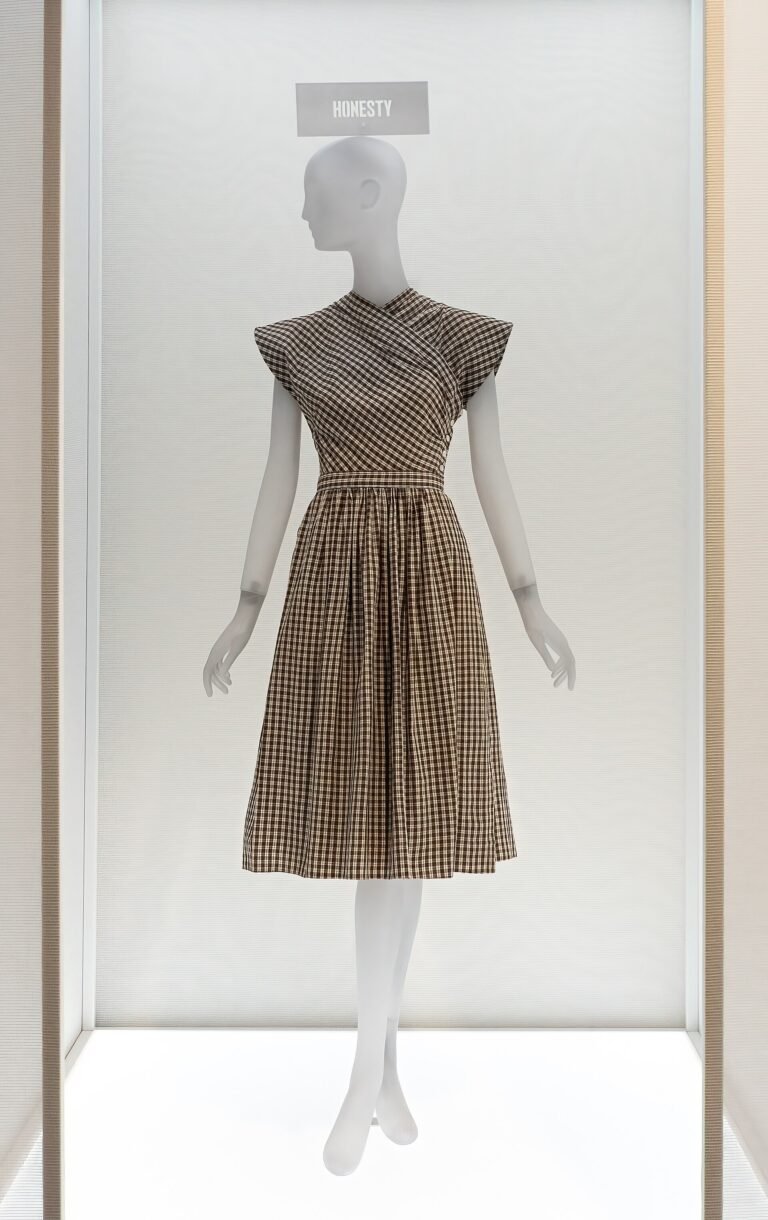
The pairings are meant to feel equivalent. Objects are shown on pedestals and platforms, and the mannequins wear heads with polished steel surfaces, designed by the artist Samar Hejazi, that reflect the visitor. In a preview quoted by The Art Newspaper, Bolton put the aim plainly: “It’s not very radical to show art and fashion side by side, but I think our perspective is quite radical because normally when art and fashion are shown beside one another, you’re always encouraged to view fashion through the lens of art. Fashion becomes disembodied. What I hope we’ve achieved is that you look at the art through the lens of fashion, so the art becomes embodied.”
What to look for
Some juxtapositions are formal and immediately legible. The museum’s own highlights include a walking dress from about 1883 set beside Georges Seurat’s 1884 Study for “A Sunday on La Grande Jatte”; a 2022–23 suit by Glenn Martens for Y/Project, in collaboration with Jean Paul Gaultier, paired with a first- to second-century C.E. marble statue of Diadoumenos; a 1997–98 Comme des Garçons ensemble displayed with Max Weber’s 1917 Figure in Rotation; and a 2023 dress by Dilara Findikoglu presented with an 1868 mourning brooch by Tiffany & Co.
Others ask for a slower reading. The Art Newspaper and Vogue both describe Van Gogh’s Irises (1890) flanked by two ensembles that reference the painter’s series: Yves Saint Laurent’s spring/summer 1988 haute couture and Loewe’s spring/summer 2025 collection by Jonathan Anderson. The floral echo is obvious. Bolton, speaking to both publications, pointed instead to mental health and neurodivergence. Van Gogh, he told The Art Newspaper, “suffered from mental health issues most of his life, as did Saint Laurent. Jonathan Anderson, who is dyslexic, is a huge supporter of neurodiversity.”
Why it matters now
Bolton has been clear that the show’s timing is not accidental. “I don’t think we could have done this show even ten years ago because the status of fashion has changed enormously, both within museums and within art and culture more broadly,” he told The Art Newspaper. “Twenty years ago, the question ‘is fashion art?’ was a real debate.” Costume Institute exhibitions, the paper noted, have since become some of the Met’s most visited. What is new here is not the traffic. It is the claim, made in galleries built to last, that dress can be the lens rather than the illustration.
For New York readers, the holiday season and early January are the last window for a considered visit. The show is large — nearly 400 objects, densely installed — and The Art Newspaper advised that visitors may need more than one trip to read the labels.
Plan your visit
Costume Art is on view through January 10, 2027, in Gallery 099 at The Met Fifth Avenue, 1000 Fifth Avenue, and is free with Museum admission. Confirm hours, holiday closures and tickets on the Met’s site before you go, especially around Christmas and New Year’s Day.
Read on: another New York fashion exhibition still on view in When Queens Was the Runway, and a last look at Iris van Herpen at the Brooklyn Museum, which closes December 6.
Find talent in the MOAM directory · Subscribe to The MOAM List · Follow MOAM on Instagram @moam_co and Facebook makingofamogul · Tips and corrections: hello@makingofamogul.com
Sources
- The Met, “Costume Art” (exhibition page, through January 10, 2027)
- The Met, press release: “The Met Announces Spring 2026 Costume Institute Show and Major New Galleries” (Feb 23, 2026)
- The Art Newspaper, Stephanie Sporn, “With new Costume Institute exhibition and galleries, the Met makes powerful statement about fashion’s place in museums” (May 11, 2026)
- Vogue, Laird Borrelli-Persson, “Beyond Body-Con: In the Met’s Spectacular New Exhibition, ‘Costume Art,’ the Human Form Connects Fashion and Art” (May 3, 2026)
- The Met, Plan Your Visit
Photo: “Metropolitan Museum of Art main building, 5th Avenue entrance 01” by TheCatalyst31, CC BY-SA 4.0, via Wikimedia Commons.
Editor’s note: facts in this article were checked against the linked sources in November 2026. Dates, the Condé M. Nast Galleries, the nearly 400-object count, the curatorial credits, the official body typologies and the museum’s highlighted pairings come from The Met’s exhibition page and February 23, 2026 press release. The report that objects were drawn from all 19 of the museum’s collecting departments is from The Art Newspaper; Vogue likewise describes works coming from across the Met’s collecting areas. Sections named in the review and in Vogue but not in the museum’s initial list of typologies — including the Disabled Body, the Abstract Body and the Epidermal Body — are attributed to those publications. Bolton’s remarks on looking at art through the lens of fashion, on whether the show could have been staged a decade ago, and on the Van Gogh, Saint Laurent and Loewe grouping are quoted from The Art Newspaper and, where noted, Vogue. Hours, holiday closures and admission can change; readers should confirm them on the Met’s site. The featured photograph shows the museum’s Fifth Avenue facade in October 2025, including a Divine Egypt banner and the plaza fountain, not the Costume Art galleries.